
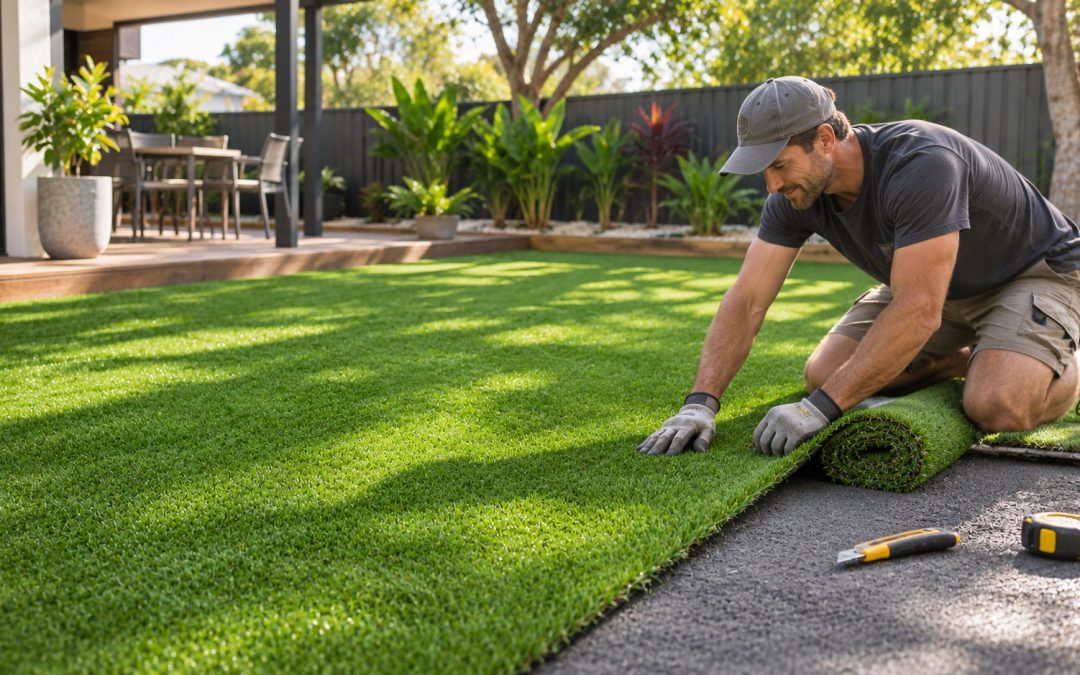
Short answer: in Australia, artificial grass usually costs about $20 to $60 per square metre for the grass alone, and somewhere between $50 and $130 per square metre fully installed. Where your job lands depends on the grass you choose, the ground underneath, and whether you lay it yourself.
| Key facts
• Supply only (DIY): roughly $20–$60/m², depending on the grass • Fully installed: roughly $50–$130/m², depending on grass, base preparation and access • A typical 50m² backyard, professionally installed: roughly $2,500–$6,000 • Removing an existing lawn can add $200–$600 + tipping fee’s if required • Base preparation, not the grass, is where most cost blowouts happen |
Those figures come from published Australian price guides (CHOICE, plus supplier and marketplace guides; sources below). Every job is different, so treat them as a starting point, not a quote.
What does artificial grass cost per square metre?
There are really two prices: the grass, and everything it takes to get the grass into your yard.
| Typical range | What you’re paying for | |
| Grass only (supply) | $20–$60/m² | The turf itself. Entry-level landscape grasses at the bottom; premium, pet and sports grasses at the top. |
| Installation labour and base | Roughly $45–$120/m² on top | Excavation, road base, compaction, weed mat, laying, joining, edging and infill. |
| Fully installed | $50–$130/m² | Everything above, done by an installer. Complex or premium jobs sit at the top. |
See our Residential landscape range pricing here: https://www.enduroturf.com.au/product-category/residential/landscape-grass/
Why is there such a big range?
Two backyards the same size can end up thousands of dollars apart. These are the things that move the price:
- The grass itself — longer, denser, softer grass costs more to make. So does grass built for a job: pet grass needs better drainage, putting greens need a tight, consistent surface.
- What’s underneath — laying on existing concrete is quick. Laying on soil means digging out, bringing in road base, compacting it and putting down weed mat. That’s where most of the labour goes.
- Drainage — clay soil, low spots or a yard that holds water may need drainage work first.
- Access and shape — if everything goes through a narrow side gate in a wheelbarrow, it takes longer. Slopes, curves and lots of garden beds add cutting time.
- Removing what’s there — pulling up and disposing of an existing lawn typically adds a few hundred dollars.
- Waste — grass comes in rolls of a fixed width [confirm Enduroturf roll widths], so an awkward shape can mean paying for offcuts. A good supplier helps you plan the layout to keep waste down.
How much does it cost to lay artificial grass yourself?
DIY is the cheapest way to get artificial grass, because labour is the biggest part of an installed price. As a rough example, a 40m² backyard using a mid-range grass at $30–$50/m² comes to about $1,200–$2,000 for the grass. On top of that you’ll need:
- Road base or crusher dust for the base
- Jointing tape and adhesive
- Infill sand
- Pins and edging
- A plate compactor, hired for the day
Most reasonably handy people can lay a standard backyard over a weekend or two. Our free install guide walks you through it for both soil and hard surfaces.
How much does professional installation cost?
Using the same 40m² backyard, a fully installed job at $75–$130/m² comes to roughly $3,000–$5,200. That buys you excavation, base preparation, laying, joins and edges done by someone who does it every week, and your weekend back.
Is cheap artificial grass worth it?
Sometimes. For a small area that doesn’t get much use, a budget grass can be perfectly fine. But the price difference usually shows up in three places:
- It flattens — thin, low-density grass flattens where people walk and doesn’t spring back.
- It fades — grass without good UV stabilisation fades in the Australian sun, sometimes within a few summers.
- The warranty — a long warranty is only worth something if the business that gave it is still around when you need it. Imported grass sold by a reseller can leave you with nobody to claim against.
The cheapest option on day one is often the most expensive over ten years, because you end up replacing it sooner.
Artificial grass vs real turf: which is cheaper?
On day one, real turf is cheaper to lay. Artificial grass catches up over time, because you’re not paying for water, fertiliser, mowing or re-turfing the patches the dog wrecked. How fast it catches up depends on how much you currently spend keeping a real lawn alive. [Link to article #2 when published.]
| Glen’s take
“The question I get most is ‘what’s the cheapest grass you’ve got?’ My honest answer is usually a question back: what’s it for? If it’s a courtyard nobody walks on and not m,any people can see, go cheap. If the kids and the dog are going to be on it every day, spending a bit more on the grass and a lot more care on the base will save you money. Nine times out of ten, when someone’s unhappy with artificial grass, it’s the base that let them down, not the grass.” |
How to get an accurate price
- Measure your area: length × width for each section, and sketch the shape
- Note what’s there now: soil, lawn, concrete or pavers
- Order free samples so you’re pricing the grass you actually like
- Then buy direct and lay it yourself, or get a quote
Frequently asked questions
How much does artificial grass cost per square metre in Australia?
Around $20–$60/m² for the grass only, and roughly $50–$130/m² fully installed, depending on the grass, the base preparation and how easy your site is to work on.
How much does it cost to put artificial grass in a 50m² backyard?
Published guides put a professionally installed 50m² backyard at roughly $2,500–$6,000. Laying it yourself costs a fraction of that, mainly the grass, base materials and accessories.
Is artificial grass cheaper than real grass?
Not upfront. Over several years it usually works out cheaper, because there’s no watering, mowing, fertilising or re-turfing.
What’s the most expensive part of an artificial grass job?
Usually the labour and base preparation, not the grass. That’s why DIY saves so much, and why a poorly prepared base is the most common cause of problems.